Pets can be one of the best parts of a resident’s home experience.
They can also become one of the most misunderstood areas in property management.
Recently, there has been significant discussion in Texas property management circles about Emotional Support Animals (ESAs), pet fees, and what landlords are or are not allowed to require.
Unfortunately, much of the online conversation oversimplifies the issue.
The reality is more nuanced.
The laws themselves have not fundamentally changed
One of the biggest misconceptions currently circulating is:
“Texas changed the laws and now landlords can charge pet fees for ESAs.”
That is generally not true.
Under Fair Housing Act guidelines, legitimate assistance animals are not considered “pets.”
That means:
- no pet rent
- no pet deposits
- no pet fees
for qualifying assistance animals.
However, what has changed over the last several years is:
- scrutiny around fraudulent ESA claims
- expectations around documentation
- operational handling standards
- interpretation around what constitutes reliable verification
And that distinction matters.
Online ESA certificates are no longer viewed the same way
For years, internet-generated ESA “certificates” became extremely common.
Many housing providers grew frustrated with:
- instant online approvals
- questionable provider relationships
- generic documentation
- inconsistent standards
Today, documentation is being evaluated more carefully.
Housing providers may generally request reliable documentation showing:
- the individual has a qualifying need
- the animal provides support connected to that need
That does NOT mean landlords can demand:
- medical records
- diagnoses
- private treatment details
But it does mean the process has become more structured and more carefully reviewed.
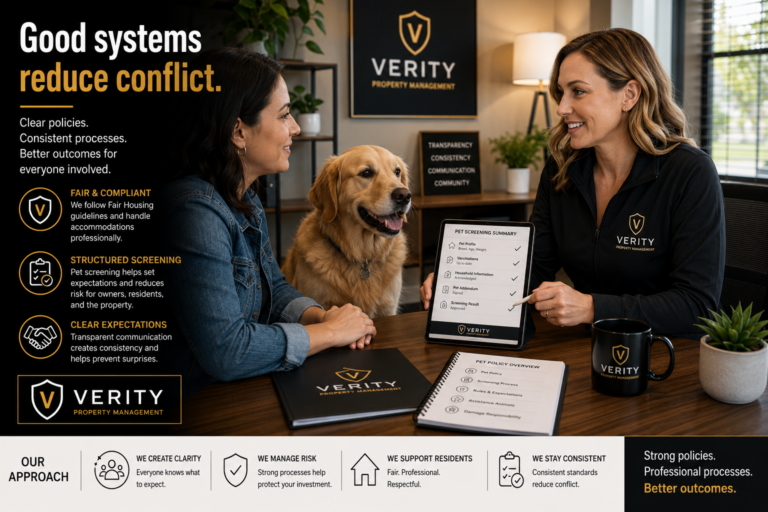
Strong policies protect everyone involved
Good pet policies are not simply about restrictions.
They are about:
- transparency
- expectations
- risk management
- operational consistency
- resident experience
At Verity, we believe pet policies should:
- be clearly communicated upfront
- apply consistently
- separate pets from assistance animal accommodations
- include structured screening processes
- reduce ambiguity for both owners and residents
Why screening matters
Pet screening is not about excluding animals.
It is about:
- verifying information
- establishing expectations
- documenting animal profiles
- reviewing vaccination records when appropriate
- identifying risk factors proactively
Strong screening processes help create better outcomes for:
- owners
- residents
- neighbors
- the property itself
Consistency matters more than emotion
One of the biggest operational mistakes property managers make is handling pet and ESA situations emotionally instead of systematically.
That creates:
- inconsistent decisions
- legal exposure
- resident frustration
- owner confusion
Strong systems reduce conflict.
Residents should understand:
- what is required
- how the process works
- what documentation is needed
- how accommodations are reviewed
Owners should understand:
- how risk is being managed
- how compliance obligations are handled
- how policies are applied consistently
The goal is balance
At Verity, our goal is not:
- anti-pet policies
- adversarial screening
- unnecessary barriers
The goal is creating a process that balances:
- legal compliance
- property protection
- resident experience
- operational consistency
- owner risk management
Because good property management is not about emotional reactions.
It is about clear systems, consistent standards, and professional execution.
Related Articles
- Tenant Screening: The First and Most Important Decision
- What does a good tenant experience actually look like?
- 5 Common Mistakes First-Time Landlords Make
- What “Good” Property Management Actually Looks Like
- The Rise of the Accidental Landlord
Let’s build a better system for your property.