One of the biggest misconceptions in business is that great people alone create scalable organizations.
They don’t.
Great people matter enormously.
But people have limits.
And property management is one of the most operationally complex service businesses there is:
- maintenance coordination
- communication
- leasing
- inspections
- renewals
- accounting
- vendor management
- emergency response
- compliance
- resident relations
At small scale, talented people can compensate for weak systems.
At larger scale, they can’t.
The “great property manager” trap
Many property management companies are initially built around one exceptional property manager.
At first, this works well.
That person:
- remembers everything
- works long hours
- knows every resident
- manually follows up on every issue
- keeps operations together through sheer effort
Owners and residents often love this person.
But eventually growth changes the equation.
The same person who was:
- excellent at 40 doors
- strong at 80 doors
can become:
- overwhelmed at 150
- reactive at 250
- inconsistent at 400+
Not because they stopped caring.
But because human capacity has limits.
Growth reveals operational truth
This is one of the most important lessons in scaling any service organization:
Growth does not create operational weakness.
It reveals it.
At smaller scale:
- memory can compensate
- hustle can compensate
- heroics can compensate
At larger scale:
- delays compound
- communication gaps appear
- follow-through weakens
- accountability becomes inconsistent
- bottlenecks emerge
The organization becomes increasingly dependent on extraordinary effort just to maintain basic service levels.
That is not sustainable.
Heroics are not a growth strategy
Many companies celebrate “rockstars” and “super PMs.”
Operationally, this is often a warning sign.
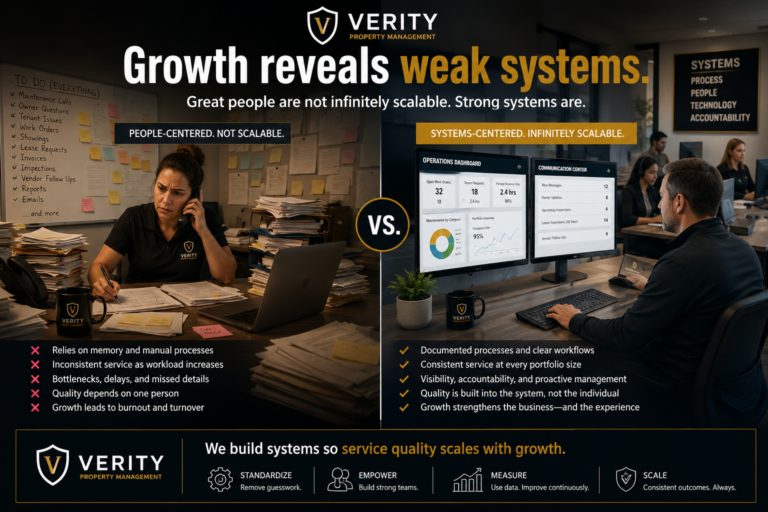
Because if the business only functions well when exceptional people constantly overextend themselves:
- burnout increases
- turnover rises
- service consistency declines
- institutional knowledge becomes trapped in individuals
Strong businesses are not built around heroics.
They are built around systems.
Strong systems create scalable consistency
Good systems create:
- documented workflows
- accountability
- visibility
- repeatable communication
- operational consistency
- predictable resident experience
Systems allow organizations to:
- train effectively
- delegate effectively
- onboard new staff
- maintain service standards during growth
Most importantly:
strong systems allow average days to produce excellent outcomes consistently.
The goal is scalable service quality
At Verity, we believe growth should strengthen operational capability—not degrade it.
That means building:
- communication systems
- inspection processes
- maintenance workflows
- documented standards
- accountability structures
- operational visibility
before scale exposes weaknesses.
Because the goal is not simply growth.
The goal is maintaining service quality as the business grows.
The bottom line
A business should not require extraordinary effort simply to function consistently.
Strong systems create:
- stability
- scalability
- accountability
- better owner experiences
- better resident experiences
Because ultimately:
great people matter.
But scalable systems are what allow great service to endure.
Related Articles
- Why Systems Beat “Good People” in Property Management
- Verity’s Core Principles
- What “Good” Property Management Actually Looks Like
- Communication Standards Matter More Than Most Owners Realize
- A Day in the Life of Property Management (What Owners Don’t See)
Let’s build a better system for your property.