Many property owners start looking for a property manager after a stressful experience.
Maybe:
- a tenant stopped communicating
- maintenance became overwhelming
- a turnover went poorly
- rent collection became awkward
- they moved out of state
- the property became too time-consuming to manage personally
For many accidental landlords, the question becomes:
“What should I actually expect from a good property manager?”
That’s an important question.
Because good property management is much more than:
- collecting rent
- coordinating repairs
- posting listings online
At its best, property management is operational risk management.
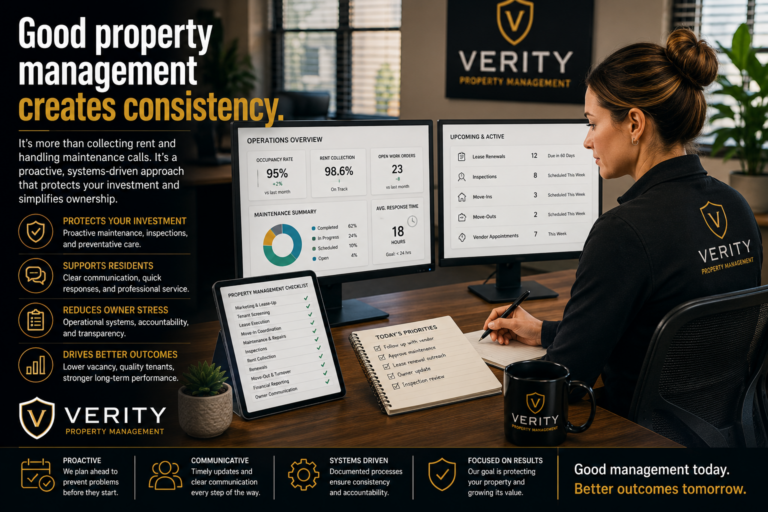
Good property management creates consistency
One of the biggest differences between average and strong property management is consistency.
Good management should not depend entirely on:
- memory
- personality
- improvisation
- constant owner intervention
Strong systems create:
- repeatable communication
- proactive maintenance
- inspection schedules
- documented processes
- accountability
- operational visibility
Owners should feel like there is a clear process behind the management—not chaos behind the scenes.
Good property management is proactive—not reactive
Many poor management experiences happen because problems are only addressed after they become emergencies.
Strong property management focuses on:
- preventative maintenance
- inspections
- lease-up planning
- renewal communication
- proactive vendor coordination
- early issue identification
The goal is not just solving problems.
It is reducing how often problems occur in the first place.
Communication matters enormously
Many owner frustrations are not caused by the original issue itself.
They are caused by uncertainty.
Good property management should create:
- visibility
- transparency
- timely updates
- clear expectations
- confidence that issues are actively being managed
Owners should not feel disconnected from their own investment.
Good management balances owners and residents
Strong property management protects the owner while also supporting the resident experience.
Those goals are not opposites.
Well-maintained properties, clear communication, structured processes, and professional expectations create better outcomes for everyone involved.
Good management is not:
- adversarial
- emotional
- reactive
It is structured and professional.
Good property management scales through systems
One of the biggest operational mistakes property management companies make is relying entirely on extraordinary individuals instead of scalable systems.
As companies grow, weak systems create:
- slower communication
- inconsistent follow-through
- reduced accountability
- service degradation
Strong systems allow service quality to remain consistent even as operations become more complex.
What owners should look for
When evaluating a property manager, owners should ask:
- How are inspections handled?
- What communication standards exist?
- How are maintenance decisions made?
- What systems support operations?
- How are turnovers managed?
- What does lease-up coordination look like?
- How is accountability maintained?
The answers to those questions often matter more than marketing promises.
The bottom line
Good property management is not:
- collecting rent
- answering calls
- reacting to problems
It is creating systems that:
- protect the property
- support residents
- reduce owner stress
- improve long-term outcomes
- create operational consistency
Because ultimately, owners are not simply hiring someone to manage tasks.
They are hiring someone to manage operational complexity.
Related Articles
- What does great property management look like for an owner?
- Verity’s Core Principles
- Communication Standards Matter More Than Most Owners Realize
- What Good Owner Communication Actually Looks Like
- How Much Does Property Management Cost?
Let’s build a better system for your property.