The Phone Call Nobody Wants
It’s July.
Outside temperatures are 103°.
A resident reports: “The AC isn’t cooling.”
At that moment, nobody knows whether the issue is:
- a clogged drain line
- a failed capacitor
- a bad blower motor
- low refrigerant
- a failed compressor
- a complete system replacement
The diagnosis matters.
Because every path forward looks different.
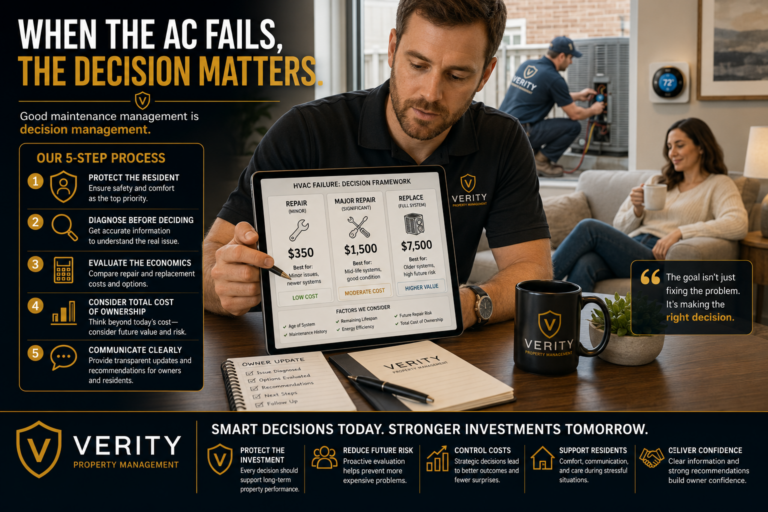
Step 1: Protect the Resident
The first priority is always habitability and resident safety.
Questions include:
- Is the system completely down?
- Is it partially cooling?
- What is the indoor temperature?
- Are there health concerns?
- Are there vulnerable occupants?
Not every HVAC call has the same urgency.
But every HVAC call deserves a prompt response.
Step 2: Diagnose Before Deciding
One of the most expensive mistakes owners make is making decisions before understanding the actual problem.
The technician’s diagnosis often determines:
- repair cost
- replacement cost
- expected lifespan
- future risk
Good decisions require information.
Step 3: Evaluate the Economics
This is where strong property management creates value.
Consider:
Option A: Repair: $350
Option B: Repair: $1,400
Option C: Replacement: $7,500
The cheapest option isn’t always best.
The most expensive option isn’t always necessary.
Important considerations include:
- age of system
- maintenance history
- expected remaining life
- energy efficiency
- likelihood of future failures
Step 4: Consider Total Cost of Ownership
A 12-year-old unit requiring a $1,500 repair may deserve a different conversation than a 3-year-old unit requiring the same repair.
Good decisions consider:
- future repairs
- reliability
- resident disruption
- energy efficiency
- duplicate labor costs
The goal is not minimizing today’s invoice.
The goal is optimizing long-term ownership outcomes.
Step 5: Communicate Clearly
Owners should understand:
- what failed
- available options
- costs
- risks
- recommendations
Residents should understand:
- status
- expected timeline
- next steps
Clear communication reduces uncertainty during stressful situations.
The Goal
Good property management is not simply fixing equipment.
It’s helping owners make informed decisions under uncertainty.
Related Articles
- What Happens During an Emergency (And How We Decide What to Do)
- 7 Common Maintenance Issues in North Texas Rental Properties
- Maintenance Isn’t About Fixing Problems—It’s About Making the Right Decision
- Water Damage Scenario: Why Response Matters More Than the Leak
- What Counts as Emergency Maintenance?
Let’s build a better system for your property.