
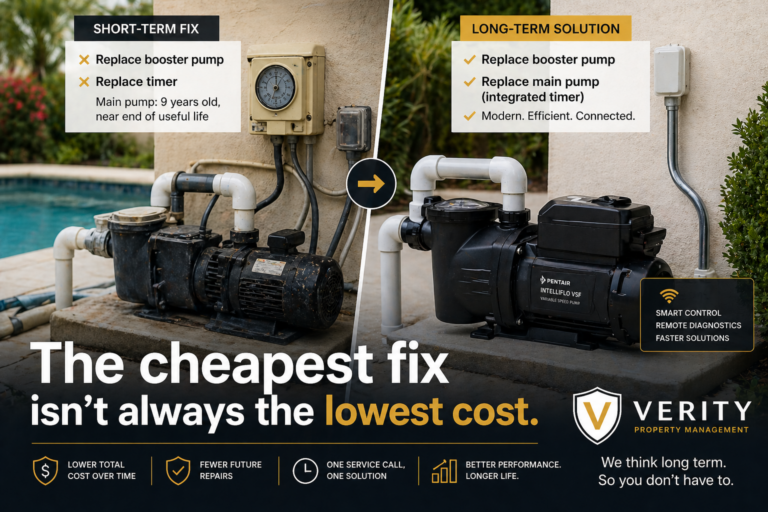
A recent situation illustrates how we approach maintenance decisions.
One of our properties had two issues:
- the pool booster pump failed
- the main timer failed
Both could be replaced individually to get the system back up and running.
That would have been the simplest solution.
But not the best one
The main pool pump was about 9 years old.
It was still working—but nearing the end of its expected life.
At the same time:
- newer pumps include integrated timers
- meaning a new standalone timer could soon become obsolete
Two options
Option 1: Replace only what failed
- lower upfront cost
- but likely another repair soon
- potential wasted spend on the timer
Option 2: Replace strategically
- replace the main pump now
- eliminate the need for a separate timer
- modernize the system
- avoid a second service call
The decision
We recommended replacing the main pump as part of the repair.
This added about $900 upfront.
But over time, it:
- avoided redundant costs
- reduced future failure risk
- eliminated unnecessary components
- improved system functionality
It also enabled remote diagnostics and control, allowing us to troubleshoot issues more efficiently in the future.
The bigger takeaway
Maintenance decisions shouldn’t be made in isolation.
They should consider:
- remaining useful life
- system design
- future costs
- operational efficiency
The bottom line
The cheapest option today isn’t always the lowest cost over time.
At Verity, we focus on making the right decision—not just the easy one.
Related Articles
- The Cheap Fix Is Usually the Expensive One
- Preventative Maintenance: The Easiest Way to Protect Your Investment
- Vendor Management: How We Ensure Quality and Accountability
- The HVAC Failure Scenario: How Good Property Managers Make Decisions
- Understanding Maintenance Costs: What Property Owners Are Actually Paying For
Let’s build a better system for your property.