When property owners think about maximizing rental income, the conversation often focuses on achieving the highest possible rent.
While rental rate is certainly important, many owners overlook a far more expensive factor:
Vacancy.
In fact, one extra month of vacancy can easily cost more than accepting a slightly lower rent from a qualified tenant.
Understanding the true cost of vacancy can help owners make better decisions when pricing, marketing, and leasing their rental properties.
Vacancy Costs More Than Lost Rent
Most owners calculate vacancy by looking at the rent that wasn’t collected.
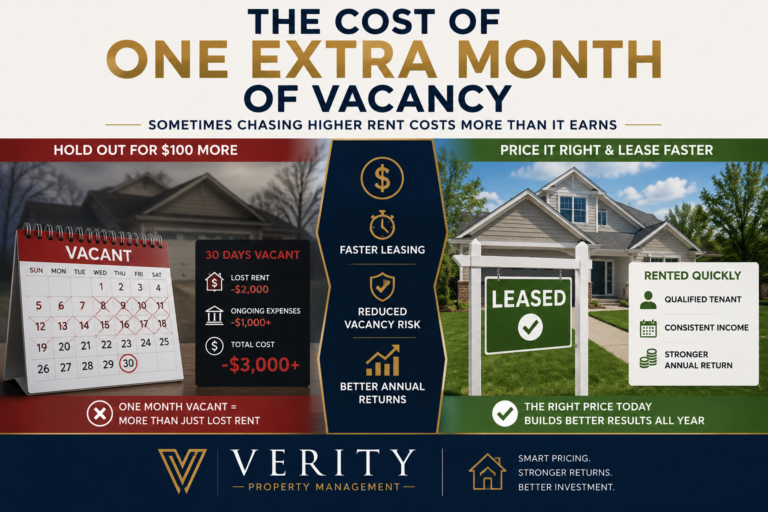
If a property rents for $2,000 per month, one vacant month appears to cost $2,000.
In reality, the cost is often significantly higher.
During a vacancy, owners may continue paying:
- Mortgage payments
- Property taxes
- Insurance
- HOA dues
- Utility expenses
- Lawn care and maintenance
- Security monitoring
- Property management fees related to leasing activities
The property continues generating expenses even while producing no income.
The $100 Mistake
Determining the right rental price requires balancing potential rent against vacancy risk and current market conditions. Read More: How We Evaluate Rental Pricing
Consider a simple example.
An owner believes their property should rent for $2,100 per month.
The market indicates the home will likely rent quickly at $2,000 per month.
The owner decides to hold firm at $2,100.
After a month without a qualified tenant, the property eventually rents for the original $2,000 market rate.
The result?
The owner lost approximately $2,000 in rent to gain an additional $100 per month that never materialized.
Even if the property eventually rents for the higher amount, it can take many months to recover the income lost during the vacancy period.
Sometimes the pursuit of maximum rent actually reduces total annual income.
Vacancy Creates Additional Risk
Long vacancies create more than financial losses.
Extended vacancies can also increase:
- Deferred maintenance issues
- Utility-related problems
- Security concerns
- Vandalism risk
- Insurance complications
- Property deterioration
An occupied property is often a healthier property.
The longer a home sits empty, the greater the potential for unexpected issues to emerge.
Market Momentum Matters
The first few weeks after a property is listed are often the most important.
New listings typically receive the highest level of attention from prospective tenants. If a property is priced appropriately and marketed effectively, it can generate significant interest during this initial period.
When a property sits on the market too long, prospective renters often begin to wonder why.
Questions may arise:
- Is something wrong with the property?
- Is the owner unrealistic?
- Are there hidden issues?
The longer a property remains available, the more difficult it can become to generate urgency among prospective tenants.
Professional presentation helps maximize interest during the critical first weeks a property is listed. Read More: Why Great Photos Lease Properties Faster
Pricing and Marketing Must Work Together
Reducing vacancy requires more than simply lowering the rent.
Successful leasing is usually the result of several factors working together:
- Competitive pricing
- Professional photography
- Broad advertising exposure
- Responsive communication
- Property readiness
- Effective tenant screening
A well-priced property with poor marketing may still struggle.
Likewise, excellent marketing cannot fully overcome unrealistic pricing.
The strongest results occur when pricing and marketing support one another. Read More: What “Good” Property Management Actually Looks Like
The Goal Is Annual Income
Many owners focus on maximizing monthly rent.
Experienced investors often focus on maximizing annual income.
Those are not always the same thing.
A property that rents immediately for $2,000 per month may outperform a property that sits vacant for a month while attempting to secure $2,100 per month.
The objective should be maximizing total return over time, not simply achieving the highest advertised rent.
How Verity Property Management Helps
At Verity Property Management, we help owners balance rental pricing, marketing, and market conditions to reduce vacancy and maximize long-term returns.
Our goal is not simply to achieve the highest asking rent. Our goal is to help owners achieve the best overall financial outcome. Owners who understand the leasing process are often better positioned to make informed pricing and marketing decisions. Read More: Understanding the Lease-Up Timeline: What Owners Should Expect.
Sometimes the most profitable decision is not the highest rent. It’s the rent that attracts the right tenant at the right time.
Related Articles
- How We Evaluate Rental Pricing
- Why Great Photos Lease Properties Faster
- Understanding the Lease-Up Timeline: What Owners Should Expect
- What “Good” Property Management Actually Looks Like
- How Verity is Different
Let’s build a better system for your property.