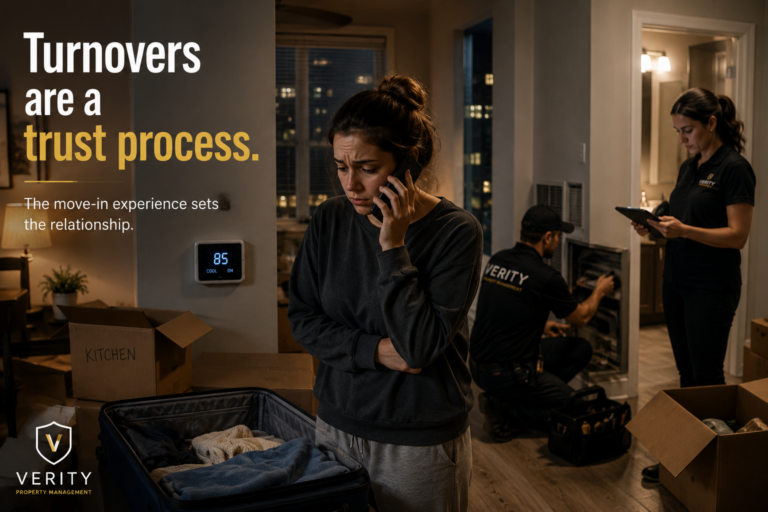
A young woman moved into her corporate housing apartment recently for a summer internship.
The company had leased several units in the same apartment community for interns working nearby. This should have been a smooth, standardized move-in process. Instead, almost everything that could go wrong did.
The move-in instructions included a gate code and lockbox code. The codes were wrong.
She stood outside the gated property for nearly twenty minutes until another resident happened to let her in. After multiple calls, she finally got someone to provide the correct code to access the lockbox attached to the apartment door.
The lockbox was empty.
After several more hours, someone finally arrived with a physical key so she could enter the apartment. Once inside, she realized the air conditioning was not working. The apartment was over 85 degrees, even after running the thermostat for hours.
Then came the final blow.
The apartment had clearly not been cleaned properly. Dust and dirt covered the floors. Her socks turned black walking through the unit. There were hairs in the shower. The leasing office was closed for the weekend and nobody seemed reachable.
Eventually, her employer’s HR department escalated the issue and things began moving quickly. The HVAC issue was resolved later that night.
But by that point, the damage had already been done.
And that is the lesson.
None of these individual problems were catastrophic on their own:
- wrong code
- missing key
- dirty apartment
- AC issue
- closed office
But together, they created something far more damaging:
a complete collapse of trust.
The resident’s first impression became: “Nobody checked this. Nobody cared. I’m on my own.”
That feeling is incredibly difficult to reverse once it forms.
This is one of the biggest misconceptions in property management:
Most companies think turnovers are a maintenance and cleaning process.
They are not.
Turnovers are a trust-building process.
Residents decide very quickly how they feel about management. Often within the first few hours of move-in. Every detail communicates something:
- Was the property actually inspected?
- Did anyone verify the lockbox?
- Was the HVAC tested?
- Did anyone walk the unit after cleaning?
- Is there an after-hours escalation path?
- Does anyone truly own the final quality check?
When those answers appear to be “no,” residents begin the relationship defensively.
And once that happens, every future issue becomes emotionally amplified.
If the AC had failed three months later after an otherwise flawless move-in, the reaction likely would have been:
“Things happen.”
But after a series of failures on Day One, the reaction becomes:
“This place is poorly managed.”
That distinction matters enormously.
The operational reality is that turnovers are one of the highest-risk moments in property management because so many handoffs occur simultaneously:
- leasing
- maintenance
- cleaners
- vendors
- utility coordination
- lockbox setup
- inspections
- scheduling
- communications
Without strong systems and accountability, small failures compound rapidly.
This is also where incentives matter.
If cleaners are paid purely on speed, quality often declines.
If maintenance teams are measured by ticket closure volume instead of verified completion quality, problems get marked “done” too early.
If nobody owns final walk-through accountability, everyone assumes someone else checked the property.
Operational failure is often not the result of bad people.
It is the result of weak systems.
And the costs are far larger than most operators realize.
Bad turnovers create:
- more maintenance calls
- more escalations
- more negative reviews
- lower renewals
- higher turnover costs
- more staff time
- more adversarial tenant relationships
A clean turnover process is not simply “good service.”
It is retention strategy.
It is operational efficiency.
It is reputation management.
It is risk reduction.
Ironically, this is also one area where smaller property management firms can outperform much larger institutional operators.
Large portfolios often rely on fragmented coordination between departments and vendors. Responsibility becomes diffused. Everyone touches the process, but nobody truly owns the resident experience end-to-end.
A disciplined local operator with rigorous checklists, clear accountability, and obsessive attention to detail can often deliver a significantly better resident experience.
Because ultimately, residents are not judging your org chart.
They are judging whether their home was ready when you said it would be.
And that judgment begins immediately.
Related Articles
- Lease Renewal Strategy: Retain or Replace with Confidence
- Why Property Inspections Matter More Than Most Owners Realize
- How We Reduce Vacancy (And Protect Your Rental Income)
- What does a good tenant experience actually look like?
- We Just Took Over This Property: Here’s What We Found
Let’s build a better system for your property.