Most Communication Problems Aren’t Communication Problems
When owners become frustrated with a property manager, the complaint is often:
“I never hear from them.” or “Nobody keeps me updated.” or “I don’t know what’s happening.”
Those concerns are real.
But in many cases, communication is not the root cause.
It’s simply where the operational breakdown becomes visible.
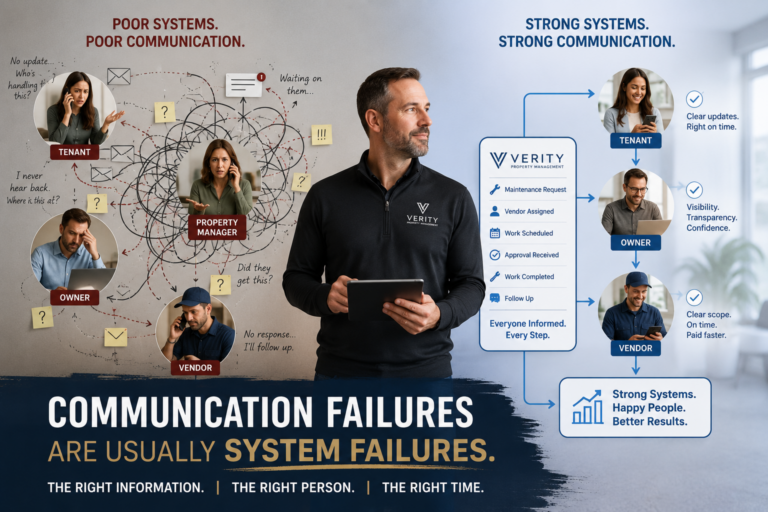
Communication failures are often system failures wearing a communication disguise.
This is one reason we place such a strong emphasis on communication standards and operational consistency. (Related: Communication Standards Matter More Than Most Owners Realize)
The Maintenance Request Example
Imagine a resident submits a maintenance request.
The process might look something like this:
Resident submits request
↓
Property manager logs request
↓
Vendor is contacted
↓
Vendor schedules visit
↓
Vendor diagnoses issue
↓
Approval is requested
↓
Owner responds
↓
Vendor schedules repair
↓
Work is completed
↓
Resident requests an update
At some point, communication breaks down.
The resident becomes frustrated.
The owner becomes frustrated.
The property manager feels overwhelmed.
Everyone believes the problem is communication.
But often the real issue is that the process was never designed to provide visibility throughout the workflow.
This is one of the reasons property management is often more operationally complex than owners realize. (Related: A Day in the Life of Property Management)
The First Cause: Too Many Handoffs
Every handoff creates risk.
Information moves from:
Resident → Property Manager → Vendor → Owner → Vendor → Resident
Each transfer creates opportunities for:
- delays
- missed details
- misunderstandings
- duplicated effort
The more people involved, the more important systems become.
The Second Cause: Unclear Ownership
One of the most dangerous phrases in business is: “I thought someone else was handling that.”
When nobody clearly owns a task, communication eventually suffers.
Strong systems establish:
- ownership
- accountability
- visibility
At every step.
This is one of the reasons Verity believes systems are ultimately more scalable than relying solely on individual effort. (Related: Why Systems Beat Good People in Property Management)
The Third Cause: Reactive Operations
Many organizations operate entirely from their inbox.
Everything becomes:
- urgent
- interruption-driven
- reactive
When teams spend all day reacting, proactive communication often disappears.
The result is a constant cycle of:
- chasing updates
- returning calls
- responding to frustration
Instead of preventing it.
The Fourth Cause: Undefined Expectations
Not all communication failures involve mistakes.
Sometimes expectations were never aligned.
For example:
An owner expects daily updates.
The property manager expects to communicate only when there is a meaningful change.
Neither side is wrong.
But without clearly defined expectations, frustration becomes inevitable.
Owners who understand what good communication actually looks like are often much more satisfied with the management experience. (Related: What Good Owner Communication Actually Looks Like)
What Good Communication Actually Looks Like
Good communication is not:
- more emails
- more phone calls
- more meetings
- more status updates
Good communication is:
The right information
Delivered to the right person
At the right time
Consistently
That’s what creates confidence.
Why Systems Matter
The strongest property management companies don’t rely on memory.
They rely on systems.
Strong systems create:
- visibility
- accountability
- ownership
- consistency
And when systems are strong, communication becomes easier because everyone knows:
- what is happening
- who is responsible
- what happens next
This is ultimately one of the defining characteristics of good property management. (Related: What Good Property Management Actually Looks Like
The Bottom Line
Communication problems rarely begin with communication.
They usually begin with:
- broken processes
- unclear ownership
- excessive handoffs
- reactive operations
At Verity, we believe communication should be the result of strong systems—not a substitute for them.
Because the goal isn’t simply more communication.
It’s better communication.
Related Articles
- Communication Standards Matter More Than Most Owners Realize
- What Good Owner Communication Actually Looks Like
- A Day in the Life of Property Management
- Why Systems Beat Good People in Property Management
- What Good Property Management Actually Looks Like
Let’s build a better system for your property.