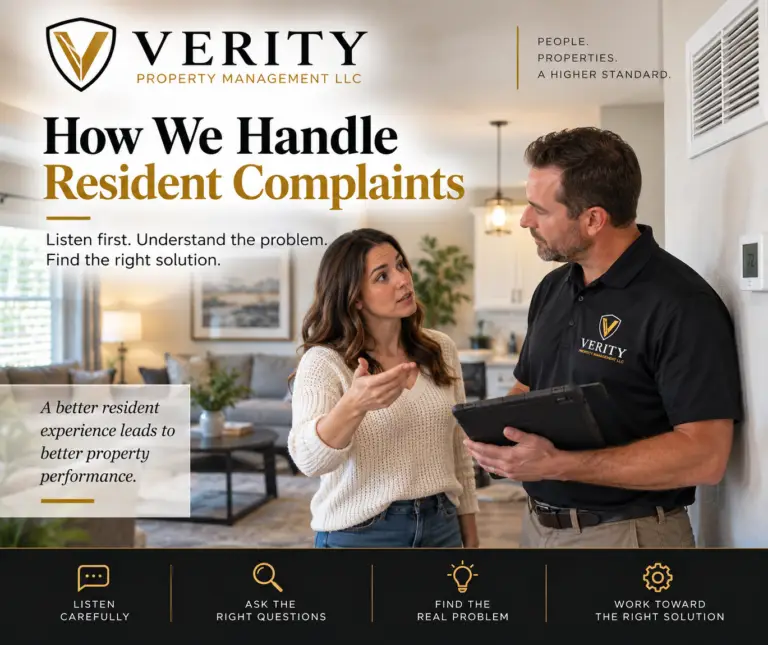
Nobody wants to receive a complaint.
But in property management, complaints can be extremely useful.
A resident lives in the property every day. They see, hear and experience things that an owner or property manager cannot possibly observe from somewhere else.
When a resident tells us something is wrong, our first responsibility is to listen.
But listening doesn’t always mean doing exactly what the resident asks.
Sometimes good service requires figuring out what they’re really telling us.
The Complaint and the Problem Aren’t Always the Same Thing
Imagine a resident submits this maintenance request:
“The air conditioner needs to be replaced. It doesn’t work.”
There are several ways to respond.
We could reject the request because the resident doesn’t get to decide when an HVAC system is replaced.
We could immediately send someone to quote a replacement.
Or we could start asking questions.
What isn’t working?
Is the system running?
What temperature is the thermostat set to?
What is the temperature inside the home?
Is the entire house uncomfortable or only certain rooms?
When did the problem begin?
Did anything change?
Those questions aren’t an attempt to avoid addressing the complaint.
They’re how we identify the complaint.
The resident may believe the problem is an old air conditioner.
The actual problem might be a failed capacitor, clogged condensate line, dirty filter, thermostat issue, duct problem or something else entirely.
What the resident really needs isn’t necessarily a new air conditioner.
They need a comfortable home.
That’s the problem we’re trying to solve.
Listen for the Problem Behind the Requested Solution
This happens outside maintenance too.
A resident may say:
“I want the tree removed.”
Why?
Perhaps a branch is scraping against a bedroom window every night.
“I need a new refrigerator.”
Why?
Maybe food is freezing in the refrigerator compartment.
“You need to send pest control.”
Why?
Perhaps the resident is seeing insects around one particular window where a damaged screen is actually allowing them inside.
In each case, the resident has already moved through the problem-solving process in their own mind:
I have a problem → I think I know why → here is what you should do.
That’s perfectly normal.
We all do it.
Good property management separates those pieces again.
What is the resident experiencing?
That’s where we start.
Taking Someone Seriously Doesn’t Mean Automatically Agreeing
This distinction matters.
There is a big difference between telling someone:
“No, we’re not doing that.”
and:
“I understand why you’re asking for that. Let’s make sure we understand what’s causing the problem so we can determine the right solution.”
The ultimate answer might still be no.
But the resident should understand that the underlying concern was heard and investigated.
Sometimes the resident’s proposed solution will be exactly right.
Sometimes there will be a better one.
And occasionally, investigation may reveal a bigger problem than the resident realized.
That’s why the goal isn’t simply to process requests.
It’s to understand problems.
Complaints Can Be Early Warning Systems
There is another reason we want residents to communicate with us.
Small complaints can reveal developing property problems.
A resident mentioning a faint water stain may help identify a roof leak before substantial interior damage occurs.
A strange HVAC noise may precede a system failure.
A door that suddenly becomes difficult to close could indicate movement that deserves investigation.
Repeated electrical issues could signal something more significant than an inconvenient outlet.
Not every complaint reveals a major problem.
Most won’t.
But we’d much rather know about something early enough to investigate it than discover months later that a resident stopped reporting issues because they didn’t believe anyone was listening.
Good communication protects both the resident and the property.
Look for Patterns, Not Just Individual Requests
Property management systems also allow us to see something an individual resident or owner might not:
history.
A single maintenance request may seem minor.
The fourth request involving the same issue deserves another look.
If a repair has been performed repeatedly but the problem keeps returning, continuing to make the same repair may no longer make sense.
The maintenance history might suggest that the original diagnosis was incomplete or that replacement has become more economical than continued repairs.
This is another reason documentation matters.
Each complaint shouldn’t disappear when the maintenance ticket closes.
Together, those records tell the story of the property.
Communication Continues After the Decision
Solving the technical problem is only part of good service.
The resident also needs to understand what happened.
What did the vendor find?
What is being repaired?
Does a part need to be ordered?
Is another visit required?
Is the requested solution unnecessary?
Is something the resident needs to do?
Even a reasonable decision can feel unreasonable when nobody explains it.
And when something can’t be resolved immediately, communication becomes even more important.
A resident may be much more understanding of a delay when they know why there is a delay and what is happening next.
Silence tends to create frustration.
Residents and Owners Ultimately Want the Same Thing
It’s easy to frame property management as balancing competing interests.
The resident wants everything fixed.
The owner wants to control expenses.
Certainly, disagreements sometimes happen.
But most of the time, the interests are much more aligned.
Residents want a safe, comfortable and properly functioning home.
Owners want a well-maintained property occupied by residents who take care of it and want to stay.
Those goals reinforce each other.
Listening carefully to resident concerns helps us identify legitimate problems earlier, make better maintenance decisions and protect the condition of the property.
That’s good resident service.
It’s also good asset management.
Solve the Problem, Not Just the Request
At Verity Property Management, we believe a maintenance request or resident complaint should begin a conversation, not simply trigger a yes-or-no decision.
Listen.
Ask questions.
Understand what the resident is experiencing.
Investigate when appropriate.
Determine the underlying problem.
Then choose the appropriate solution.
Sometimes that will be exactly what the resident requested.
Sometimes it won’t.
The measure of good service isn’t whether we always say yes.
It’s whether we took the concern seriously enough to understand the problem and work toward the right solution.
Because sometimes the best way to give someone what they need is to first understand why they’re asking for what they want.
Related Articles
- Why Lease Enforcement Protects Everyone
- How Clear Expectations Prevent Lease Violations
- The Hidden Costs of Deferred Maintenance
- Wear and Tear or Tenant Damage? Understanding Who Pays for What
- Why Property Inspections Matter More Than Most Owners Realize
Let’s build a better system for your property.